Monday, September 27, 2010

Steve Rood - Photography then, now and what it will be

The Lecturer of the week is Steve Rood. I have never had a chance to meet Steve prior to the class, so i was excited to hear from an artist that i haven't talked to before. It was extremely handy that Steve had given the class his website which had the lecture content.

http://www.rood.co.nz/talk/


I really like Steve's good sense of humor and it shows through in some his art practice. Generally i find photography difficult, however i actually really enjoy the works from Steve, as they have a very soft illustrative and narrative effect which i personally see similar to a painting. So i found Steve's photographic works very interesting and fun.


Steve began the class by showing us the first photo he took when he was kid, which was a black and white photo of a pile of compost. Sometime later on the same day after he took the photo, the compost caught on fire and had to be put out by the fire department. This inspired Steve to continue down the path as a photographer as he was fascinated at the thought of capturing images of objects and what will happen to it next. I like how he used a mini fire extinguisher as his catalogue' for this photo, which had the story behind the work on the back. I find this idea humorously symbolic of the burnt compost and also somewhat in a way very practical, (great sense of irony right there.)


Steve continued by showing us a list of great influences that helped him in his practices, the list was shown as a red square with names flashing very fast. I had fun trying to capture some of the names. It interested me to see that the name Diane Arbus poped up, because Steve's photos are


very beautiful as well as formal, while Diane Arbus was known for her photo taking of 'freaks'. The subject of her works are often described as 'deviants' or 'marginal'. However i do see a similar photographic lighting style with Steve's earliest compost photo. I would assume it would probably because of the same use of natural lighting. Which i see as a very strong element in Arbus's works, as it suggests a harsh sense of reality. It also reminds me of the series of friend portraits from Steve, as the images are harshly lighted, but in a very selective way, especailly the eyes.


I also thought it was very nice of Steve mentioning 'mum' in the list of inspirations.


As the compost incident introduced Steve into a life-long dedication of photography, Steve first started taking on photography career in London as a documentary photographer. I think most of Steve's works have the traditional formality quality that reminds me of documentary photographs. The first series of works Steve showed us was from when he worked for fashion industries. This series of images by Steve as he explained was over exposed and out of focus, reducing the subjects to a point of hardly nothing and it's most sensual form.
Steve also explained that it's also how he picture clients, which i could relate to, as during my study of fashion at AUT i learnt to see models as simple structures. I was really fond of the picture of the plastic bag. At first i thought it was a flowing silk garment, it's only after Steve told us it's actually a plastic bag i realised how beautiful a piece of rubbish can be captured in art. This idea reminded me of Francis Hansen, who made artworks out of old and unwanted baskets. Immediately the audience would start seeing the object in a new light.
Later Steve moved back to NZ worked with food photography for cook books. I thought the nik-name 'pouring guy' was quite funny. The pouring works have the same style of lighting like his fashion shots. The white background with high color contrast that accentuate the objects. Steve's photos are visually pleasing for me, as the lighting of Steve's works are quite feminine and soft. which is mostly shown in the skincare photos.

The next series of works is of lamp light structures that projects light from the light bulb inside the structures. Steve explains that lighting in photography is always being shined upon, so he want to reverse that and explore the light comming towards the camera instead, so the light cast shadows of the form of the lamps.


Uptill now Steve's practices have been very traditional photography. Steve decided to further his career with his photographic talent by doing a master degree at AUT. And at AUT he made a digital media portraits, called 'project George'. Project George is a collection of fond images that was in an interactive and narrative manner. I like how the little postcards moves around an image and by random they come to contact and the image change. I think it's indeed just like how Steve described it, 'narrative postcards'.
I think at this point Steve's practice is moving into a more modern phase. He began working for website designs, he also mentioned websites like CPRW Fisher and Rita Studio which were infact architecture websites. Because of the close relation between architecture and photography, as they both need each other, Steve with the help from his group of designers and photographers worked for websites to provide them some extra earnings to supports their photography passion. Which is something i wish i can do for myself, like Allie from class who's printing t-shirts for a source of extra money, i would love to do what i love and earn an extra income from it, at the same time, getting my name out there.

Steve ended the session by showing us the history of photography. It began with sketching in 1400, a mirrored device was used to reflect the image onto paper. This technique lasted till around 1838. Which reminded me the pantograph my class made for Deborah Crowe's class. I think it's very clever for people back in the days to invent tools that did what modern technologies are able to do. Then classic painting became the closest thing to photographs as traditional oil paintings are so realistically detailed. Then finally the invention of camera came in around the 1800s and photography replaced oil paintings at that time, and it was heavily debated wether if photography is art. I liked the series of still shots by Edward Maybridge who too photos of a horse running, and proved that when a horse runs at one poin all four of it's legs are all completely off the ground. Steve then pointed out something i have not thought much about before, which is a moving image is a sequence of stills. Lastly Steve ended by showing the lastest way to share photos, websites like flikr and Glastonbury's glastotag, where you can tag names of youself or friends that attended the event.

Steve's lecture was very inspiring, as im currently on the moving image rotation with Rebecca Hobbs. So i thought this talk was very helpful indeed. Steve also opened my eyes to the history progression of photography, and how it has changed through out history. I personally think his own practice is very much like the changing process of photography, as he began his career doing very traditional and formal photographic shooting, then slowly moved to constructing website deisgns which he take advantage of his photographic skills and then lastly Project George was a very fun story like slide show that engages the audience. I wish to follow up on more works from Steve in the future and see how he will do for the next phase of photography.






Monday, September 20, 2010

Fran Allison - Collabration vs collective

1. Define collaboration and how it differs from a collective.


2. How have these terms influenced Fran's practice.


3. Give an example of collaborative art practice.


This week we had Fran to host the lecture for the class. I don't have Fran for class this year, so i am curious what field of art she specialises in. Prior to the lecture i know that Fran work with jewellery along with Mary Curtis, so i am intrigued to compare the two jewellers. Also this is another opportunity for me to understand the process of constructing 3D artworks better, as i am still quite a stranger when it come to translating my idea into something 3D.


Fran is a member of a group of artists called 'Weeds', along with Andrea Daly, Shelley Norton and Lisa Walker. Despite they have made many collaborative works, Fran explains that 'Weeds' is still a collective of artists. Fran went on by explaining the difference between a collaboration and a collective. Although both involves having a group of participating members, the two terms are actually very different. As Fran states, a collaborative group is having all members working together to construct a piece of work together, each person might get assigned to do a particular job to do, yet most of the time the aim is to help each other. And in the end the work is put together by the entire group.


Where as a collective is having each member making a piece of artwork individually that contributes to the group as a whole. Therefore the participants are recognized as a group of artists, however at the same time the group doesn't necessarily agree with each other's ideas on art and each member make their own separate artworks.


Fran told us that 'Weeds' was formed after a visit to the show of Bone.Stone.Shell. As Bone.Stone.Shell is well known internationally, it is how the world knows of jewellery of NZ.


Fran and the other NZ jewellers felt angry at the fact the change in progress of NZ's society along with it's contemporary art still not being noticed. And with this common goal, 'Weeds' was born. I liked the joke they shared, as they said Bone.Stone.Shell sounds like tramping jewellery.


http://www.fingers.co.nz/exhibitors/Weeds_05.htm


Fran started the lecture by showing us a series of collaborative and collective groups. The first group which is also my favourite of all is 1234 Lab.


1234 Lab is a collaborative group that attended the Royal collage of Art together. Although they went to the same school, they all specialise in different aspects. As Fran explains a collaborative group is having the group working as one, the group would not be successful if a member is missing as everyone have one thing they specialise in. They make jewelleries by speaking words and translating them into 3D sound map. The necklace in the picture is actually a quote from a French actress, 'age does not protect you from love, but love somewhat protect you from age.'

Another group Fran mentioned was Workshop 6, which is a collective group which includes Areta Wilkinson, Lisa Walker, Helen O'Connor and Anna Wallis. I like how they manage their work area, as Fran explained workshop 6 allows jewellers to come work at the studio benches and also they give jewellery classes to help with the rent. Additionally i really like the way

Unnatural/naturally share ideas by sharing a sketchbook. I think this idea is fun and unique and would love to try this method with some friends myself.

Fran continued by going through her years of artmaking with the class. She started off with a design course along with metal work and jewellery. She began working as a metal smith making design domestic objects. It is then Susan Con a jeweller Fran is friend with, inspired her to work into small scale works like jewellery. Fran explained that she like to explore the 'accidents' in art-making. She enjoy the idea of not knowing what will happen and the lack of control. I see a close connection to her domestic theme with Francis Hansen's artworks. Both artists's work carries a 'domestic house-wife' motif, that is inspired by what is found around the house and everyday life. Such works like the rings Fran made out of her son's toys, and the 'Wife' ring (which was my personal favourite because of the sense of humor) which was a ring that is made out of precious material just like a wedding ring, however with words such as 'cooking,cleaning,f--king...ect' carved on it, also suggests what's happening in her life that inspired her to make the works. And just like Francis Hansen and Mary Curtis, Fran make works by recycling the materials she use, like she said 'objects carry stories just like a person, by reusing an object it's like carrying on with the story, layering story upon a story, like meaning upon meaning.'

Like the work 'How to make a necklace from a frock' The neck is made out of the cut out circles of the dress. With one material two artworks was constructed.


http://www.objectspace.org.nz/programme/works.php?documentCode=676


I think Fran's art making is a form of collaboration itself. She have merged all the different skills in different fields together through out her working experience and 'collaboratively' produce works. I really like how she also brings the skills she have from food model making into her works as well, it sounds like fun making metal works that look like chocolate.

Additionally i think her works also need to the collaboration of the audience. Like the work 'Soap', which is a ring inside a rose scented soap, washing is required to gain the ring. So to me the piece is most successful as the work start to progressively change toward the final product when there is interaction between the work and the viewer. Such interaction with the audience is very similar to Dion Hitchen, who often involves the audience into interaction with the artwork.

An collaborative group that i really like is Rise industries http://riseindustries.org/

This work is an installation of a 'handmade-magazine' that was set up in the public space and passing by audience can leave their own messeges too. I really like this collaborative art as it also involves the audience collaboration as well. Which is very similar to Fran Allison as well as Dion Hitchen's involvement with the viewers.


I really enjoyed Fran's lecture and i also really like her works, which are very cute and feminine. I am also very keen to make more interactive artworks with some classmates as well, as the collaborative work my group made for my sculpture paper was very fun.
I am interested to see more works from Fran.


Monday, September 13, 2010

Deborah Crowe - texitle and art

Blog Qn: What is Deborah Crowe's 'one idea' made up from and how does it keep recycling in various works?

This week we have lecturer Deborah Crowe to give us the lecture on her practice. I have been interested in learning what field Deborah explores in her artworks, as i have not had any classes with her yet. I was also intrigued in seeing how she would construct her works, since i have heard she deals with both 2D and 3D aspects of art. I feel like this would help me greatly in understanding and relating myself more into the fields of 3D art works.

Deborah stated that she construct drawings by using collage techniques, however she also uses the atmosphere as a tool, such as light, mood, sound and voices. She majored in textile and design along with having a passion for art. It's very inspirational to see her combining skills from the two elements into art making, i had too taken fashion, I wish i can learn to incorporate textile techniques into the works i make.
Deborah is known as a strict teacher as i heard from classmates that had been in her class previously, it's a quality she explores in her art as well. She explains that she have great fascination in the sense of being restrained and contained within a space, she plays with the idea of discipline and boundaries in her works, like she said 'i like to see where the edge happens.'

It is very interesting to learn that Deborah have a favourite place to draw, unlike lecturers before who showed photographs of their studio at home, Deborah told us that the Forth Railway Bridge, (a bridge in Scotland) is where she always travel to and sit under to draw. To her, it is a closed in place that lets her generate ideas, as it is an overhead structure therefore it gives a sense of the body being contained.
Her exploration of how the human body being placed in a space reminded me of Steve's study of one's placement in the world. Both artist deals with the relationship between the space and the body.
There's no definite idea for Deborah's practices, her works consists many ideas that constantly shifts. However there are some focal elements that i picked out from her slides of works. Some of the main ideas are based around containment, weaving, bridge froms and wolven like architectures. Even she admits that 'documentation of some work become the material for the next to come'.
Deborah's fascination with bridge architectural forms make me feel strongly of the ideas about being contained by woven like construction. As i can identify a relationship between the weaving of the threads of a fabric and the structure of a bridge.


One artist Deborah was greatly influenced by was Caroline Broadhead.

Broadhead explores the light and shadow which represent the present and the absence of the body. I can see similarities in Deborah's earlier works as they are very fashion orientated.

I like Deborah's work 'Adina', which means containing the body in Latin. The work shows a rather feminist connotation of the society's pressure on women, resulting the distortion of female bodies, almost in the form of torture.
This containment torture continued into the next series of works, which was the neck pieces displayed at 'fingers' gallery. But this time targeting the male body. The neck pieces are like shirt collars which was weaved of mesh, Which look extremely uncomfortable to wear. The idea of making the neck pieces out of mesh came from a joke of shirt collars being hard enough to cut into flesh. I found this series of works interesting, i like the way she deliberately made the pieces in the form of a fashion decoration that distort the body.

This lead to the collaborative work with Kim Fraser - Dual Outlook.

This piece had the same idea of containing the body in a woven form, however this time it was about creating a safe space for the body to hide in, a place away from technology. This is my favourite work by Deborah as although the piece seem very hard, it is actually very wearable. Which is almost like the reverse effect of the mesh collar pieces, Dual Outlook is apparently quite functional.

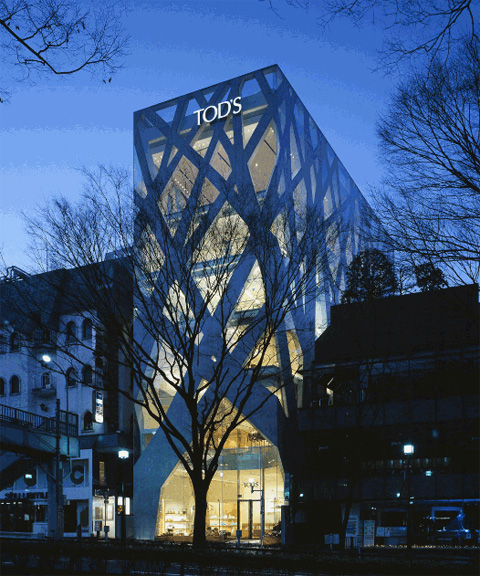
This reminds me of another artist that Deborah mentioned - Toyo Ito.
Ito's designs look like the interlocking of the threads in fabrics, which Deborah love.


Deborah explained his work as being 'concept and functional architecture', which contains at the same time being interactive.


Which is interesting to me, as i have yet to make art can be beneficial physically, it is something i want to work towards to, especially when it comes to 3D art.


I like how Deborah can combine so many ideas into one work to convey her message to the audience, but i think it is very effective. The one idea that i found being repeated in many of her works in the containment of the human body, which is always accompanied by a form that is woven. I find it hard to seperate these two as i feel that she seem to use the two ideas as one idea. I personally like this use of ideas, as i often struggle with relating one idea to another.

---
After the lecture we went to visit the gallery show 'manu toi'.
I was excited to see the works by Dion, his works are distinctive and seeing it person i really feel the interaction between the work and the audience, as i can go up close to it and walk around it. Which is important especially for a 3D artwork. I feel priviledged to be taught by a well respected art practician.
Also it reminded me that i need to start doing my sculpture homeworks..


Tuesday, August 24, 2010

Steve Lovett - What i do when im not here

Blog Question: How has Steve Lovett's practice evolved over the period of his professional career, ie. from political, social/historical concerns to issues of colour and form.

Today we had the privileged to have a presentation from our lecturer Steve Lovett. I have been keen to learn about Steve's practices as he is one of my favourite lectures. Additionally i am more interested in 2D art, therefore i really enjoy and can do well in Steve's lectures, the only other lecturer that i can relate in this way is Frances Hansen from last week. Steve always have interesting art/artists that help to inspire us in class, and i am bewildered by the amount of knowledge he has. Not only on the subject of art, but many aspects of life in general. Therefore i looked forward to see some art from Steve and what field of context he explores in his works.

In the first slide titled 'What i do when im not here', Steve written out a short summary of the ideas he work around with. His subjects are quite personal, like a story telling of one's self; a narrative background history or a private historical individual. This deals with the concept of the passing of time, the transition, and the loss that come with the change.

As it's clear to see in Steve's earlier works, which he stated many were collaborative works, the ideas are mainly revolving around the social aspects of people that makes up an individual profile, like he said, 'we ain't singular, we are social animals.'

This reminded me of Dion's social interactive works. Similar to Dion who also constructed many collaborative art works with fellow friends, and explore in dealing with self identification. Steve's ideas are about communicating between one and antoher, negoiation and understanding, as well as getting the audience to respond to the artwork.

Steve focuses on working about others, therefore he makes himself 'invisible' in his artworks. I especially enjoy the work 'Speaking Parts', the work is printed portraits of people lined next to eachother accompanied by audios of over lapped voices. I like the use of technology here as it gives the work another dimension, here the voices adds to the individual identity for each person. Just like Steve said 'we all carry story with us, which makes us who we are.'

I feel that there's a transition in Steve's ideas at this point, as he start to explore further into the idea of personal history, he started working on looking back at memories and the sense of single things gets layered. Many of the artworks after the Speaking Parts, such as 'Echo Chamber', have figures looking into the distance, as a motif of looking back at life.

An photography artist that Steve's works reminded me of is Bernard Descamps.


Descamps features figures in empty/closed in spaces looking into the distant horizon/sky, never facing the camera.
I also noticed that Steve deals quite alot with space as well, especially in the work 'Edge and Corner' where the one figure is facing a wall and another is at the edge of a cliff that descends into the ocean, which represent where one's place is in the world.

This shifts Steve into the next phase, he started working with the concept of spaces. Works he made during this time is also the most political orientated.

He made several prints that are in the format similar to a photography sequence. Some of the works that was made during this political phase are 'Trespass', 'Intersection' and 'Paradise now'

All in which are looking a series of shots, formated like a film sequence, that gives a sense time. These works deals greatly on the idea of private space vs public space, as Steve explains that the message is to show that, with the change the time, what once can be enjoyed together, becomes private and gets taken away from the public. This connects to the idea he mentioned at the beginning of class, time-transition-loss.

Steve soon started moving away from the political issues and began to focus his interest on simply the color and form in art. What started from the concept of private space vs public space, led Steve into looking at what can be seen and what was hidden hidden. Even in his most recent works, the idea on actual holes vs optical holes is still being explored. I really like Steve's most recent print, which have a hole in the middle of the page and on the back a neon orange was printed. When linning the work close to the wall, an orange glow can be seen through the hole. I was reminded of one of my favourite artworks by Yoshitoro Nara.
This is an installation by Nara that can only be seen through a peeping-hole.


I am very inspired by Steve's lecture. He was able to develop his idea further and push new ideas into what he originally started with. The idea began with personal profile and it slowly transformed into a deeper concept that deals with a political issue about privacy and publicity, finally it drifts into exploring the seen and hidden form and color. I am interested to see how his work will progress to change in the near future.
(Steve is the man)


Monday, August 16, 2010

Frances Hansen - Looking at practice: Noticing and responding

Blog question: choose at least 2 things from Frances Hansen's process list and explore in relation to her practice.


This week's lecture was on the Drawing lecturer-Frances Hansen. I was very interested in what Frances will show us since the beginning of the semester, as i did well in her class and i am better in dealing with painting and 2D related artworks than other aspects of art. Therefore it was exciting to finally see some artworks by Frances as she talks about how she come to construct ideas for her works.

Frances provided us her 4 steps in her process of art making, under each step there is a list of methods. From this lecture i found Frances's methods of 'gathering', 'composing' and 'experimenting' most inspirational.

It is amazing to see the long list of years of practices that dates all the way back 10 years. I feel so inexperienced compared to France's years of making art, considering i have only started 2 years ago. It also amazes me how fast she can generate ideas that constructs successful artworks that are refined enough to display in galleries, as she is capable of producing large amount of works within the period of a year.

Frances have a passion for collecting objects, she collects anything that holds her interest, whether it's the attraction to the physical form, or the visual imagery and sometimes just for the material. She states that she always carry a camera in her bag to document down the things that draws her attention, which i thought is a very effective way of collecting as a camera is the best tool to capture visual details. It is a habit i will try to make of. An artist Frances mentioned that relates to this practice is Patrick Pound, he did many artworks just about noticing and responding to the unsurprising objects.


This piece is called 'Landscape of Mirrors' by Patrick Pound. I really like the positive and negative effect of this piece. This concept also relates to the basket artworks from Frances, which i are my personal favourites. She paints silhouettes of household cleaning projects inside small baskets with pretty fabricated bases, that were mostly made during the 50s-80s. These are out of fashioned products that were overlooked most of the time, however Frances used these objects and transformed it to a piece of decorative artwork that can be appreciated.


Frances base her artworks on the events taking place in her everyday living. The basket with painted cleaning products reflects a feminine/domesticity aspect of her life.

I also really liked the idea of collection of plant tags that Frances mentioned. Which carries an enviormental message in her artworks. It shows that just about anything can have an artistic element that does not get acknowledged and would be often considered as rubbish. Artist like Frances collects them and reuse this waste and all the sudden people cherish what they previously thrown away as art that they hang on their walls.

After the collection of objects, Frances showed us a series of work in progress pictures taken of her work area. She describe her way of planning out the layout of each piece as 'lots of moving around and mask tapes'. She arranges her composition by constantly moving, layering and taping down the visuals temporarily. If she is not happy with the layout then this process repeats. Many of France's painting have a collage quality to it.
This reminded me alot of Marry Curtis's method of compositioning her pieces of jewelleries. Who also spends long periods of time rearranging the format of the pieces of her work and documenting her progress by taking photos of her work space.

During the endless changing process, experimenting also seem to play a key role in making a piece of successful artwork. One point i find really interesting was the way Frances adepts to site. She alters and try new ways to present her work in relation to where she will be displaying her works. This use of method seem similar to how artist Robert Rauschenburg's practices, whom is another artist Frances was influenced by. Also I personally think he is a great experimentalist with different type of medias.


'He found his signature mode by embracing materials traditionally outside of the artist’s reach. He would cover a canvas with house paint, or ink the wheel of a car and run it over paper to create a drawing, while demonstrating rigor and concern for formal painting.' - American masters.


http://www.pbs.org/wnet/americanmasters/episodes/robert-rauschenberg/about-the-artist/49/


I felt that Frances's own practice was very much like the way Rauschenburg find new ways to mark-making. The collage appearance of her artworks also relates to the pieced together element that of Rauschenburg's signature.

I really enjoyed the lecture from Frances. I also appreciate the fact she have given us a handout about her art-making process, which will be really useful for me to try some of the new ways to construct artworks. I found most interest in her ways of gathering inspirations, composing layouts and experiments that she uses. I am very keen to try her process in my own works and develop a good habit for art-making.

Additionally i really liked the add-on lecture from Tessa- A Garden of Peculiarities or Plant = Art. I even found some new interesting artists i never heard of before from the task Tessa set for the class, which was to find an artwork about plants.

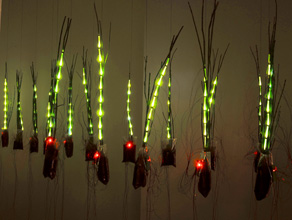
Some of my favourite new found artist are Ryan Wolfe, who constructed a installation where the plants are lit up from the inside, Sarah Sze, Nancy Rubins and Philip Ross.


-Ryan Wolfe


Tuesday, August 10, 2010

Eldon Booths- reality and illusion.

Blog question: 'using film terminology, discuss Eldon Booths exploration of reality and illusion.'


This week's topic was on Moving image by Eldon Booths. I have never done moving image before and have never met Eldon till Monday's class. So it's quite inspiring to have a lecture by someone that began as an art student just like us now. Through his study he have developed a love for writing scripts, and he dedicated his practices on his fascination of the idea on blurring the difference between 'reality and fiction'.


He began by explaining realism in terms of making a footage. Realism is an illusion created by shooting from a 1st person view, making the character a very personal subject. This technique manipulates the viewer to think that they are viewing reality. Eldon mentioned some of his critics, among which i have heard of Ramond Williams and Marion Jordan.

I found the critic that Marion Jordan did on Coronation Street rather humorous, as i am not a fan of the show, shame to say i even find it hard to watch, because the lack of exciting plot for the story to a point i see it as a show for seniors. However as Eldon explained, that is why the series is successful in capturing a vision of reality. Jordan stated in her essay 'Realism and convention', that Coronation Street is based upon working class characters, average everyday people that the audience can relate to, as well as a real location that people might have been to or lived in. This manipulates the audience into seeing the story as believable, as they would feel like they are watching their own everyday lives.

http://www.jstor.org/pss/1225036


There's many ways of portraying reality, conventional dramas like Coronation Street is a common method, where the audience is seeing from the camera's point of view, here the audience is all knowing. This is done by the counter shot format, which is done in continuity editing style where the camera cuts back and forth from characters. Eldon moved on by showing the class a short clip from E.R as an example of the camera editing. the reality is obtained from the illusion of realism, because the camera is not noticeable.
However E.R did an 'Ambush episode' that is completely different in techniques, the ambush episode was done in the style of a documentary.
Eldon mentioned a book by media scholar John Fiske - Television Culture: transparency vs Reflection, where Fiske explains that conventional dramas are the 'Reflection', that allows the audience to relate the roles of the characters, and documentaries are the 'transparency', that opens a window to the world.
http://books.google.co.nz/books?id=UttKCZIHsR8C&pg=PA21&lpg=PA21&dq=television+culture+john+fiske+transparency+reflection&source=bl&ots=d8oG-P29PM&sig=sM82KjLqXh7kyS9OS6Xqe2XSx_U&hl=en&ei=IRFmTK-NJ4jQsAOek4n3DQ&sa=X&oi=book_result&ct=result&resnum=1&ved=0CBkQ6AEwAA#v=onepage&q&f=false

Documentary is another way of projecting a vision of reality. Noted in this particular episode there are blurred focuses, lower grade of stock making the image noticeably lower quality, erratic pans of the camera due to the camera being most likely hand held and the lack of editing, lastly and most importantly the camera now becomes apparent. Characters become 'aware' of the camera and the fact they are being filmed, therefore acting unnatural, as well as making eye contacts with the lens.

which links to the next video Eldon showed us and it was a work by him. In this footage, as Eldon explains, he was using 'amateur' filming technique. The 'Amateur' method is just like the name, it doesn't require much technical skills. By using natural sound/music and following at the back of the characters, very much in the style of a documentary where as the audience in the place of the camera is the observer. There's also a use of a split screen that emphasis on the biological deterioration by comparing the grandson with the grandfather. Even though they are shown doing very different things but also very similar, like the connection in drug use, the grandfather in bed near the end of his timeline and the change in landscape.

Just like traditional paintings, modern media also evolve in trying to capture realism. Though i am unfamiliar to this topic and I have never done any moving image related practices before, i do look forward to it as it seem like a new and interesting way to explore realism through more technical approaches with modern technology.


Tuesday, August 3, 2010

Dion Hitchens- Interaction and collaboration

Blog question: Select at least 2 of the following terms and discuss in relation to Dion Hitchens's practice.


Interaction


Collaboration


Site


Cultural/history


technology (kinetic)


This week we had the lecture from Dion Hitchens about his life of sculptural practice. I have yet to have the opportunity of being in Dion's class, therefore it was very interesting to see what style his works are like. I am not familiar with 3D object making, and i have never done sculpture before, so the content of the talk was new to me. I found interaction, collaboration and site qualities very strong in his art works, and to me it is very effective. I would like to explore the above two elements relating to Dion's art making.

Dion began by explaining his inspiration for his practices, which is the Post modernism movement. This is especially important to him, as he said that he is 'thankful' that his works would be recognized and accepted by the public, which was not a thing in the past when there was alot of prejudice from western culture against non-white ethnics. Consequently Dion's works deal mainly on Maori history, in areas that he try to connect the audience physically, emotionally as well as spiritually.

I feel that there's alot of humor in Dion's sculptural installments, that allow the viewers to communicate with the work. The humorous nature of his art are often brought in by the use of technology, providing the work with unexpected movement that surprises the audience. Giving the first work he mentioned was shown in a window display. It was 3 pieces of steel forms in a glass case that oscillates while creating a soft humming sound as it moves. The way the work was installed in a window display, which in Dion's favor, was an excellent way to present the work. The audience does not need to be inside the gallery to respond to the installment. This creates a mix type of audiences: the archetype art critics/admirers that are the usual visitors of galleries and the people passing by in the street that might have never stepped in the doors of a gallery their whole life.


The work i liked the best out of all was the Patupaiarehe (faries of the forest)


Similar to the first piece he mentioned at the beginning of the lecture, this sculture also have movement. The motion done through the trigger of a sensor. As viewers walk into the room the sensor set off the figure in the photo to move. I thought it was funny when Dion told us that this work made some viewers jump, to a point that one of the other figures were knocked over by a viewer out of fright.


Dion's techniques in using the 'unexpected movement' quality is really effective in making the audience react to the work, connecting the viewer with the art work.
Another element which i thought was very interesting was his way of making use of the location where the art gets displayed.
Like in the first work of the 3 steel pieces oscillating in a glass case, site plays a important role. Just as the piece of reading talked about the relation between the art and space, as well as art using the space as a form of enforcement, 'defined primarily as an agglometration of the actual physical attributes of a particular location...with architecture serving as a foil for the art work in many instances. '
This links to the work he have situated in G.I. A form that resembles a mountain made out of steel that connects the idea of the other cultures coming to live in the area and bringing their memories along with them to the new land. This deals with how the community interact with space as well as the artwork itself.
It is interesting that i thought how closely linked the element of interaction and site of Dion's works are, as each of the two qualities seem to present the other.
Additionally from the talk i really enjoyed the idea of having really good mates that would help me in the making of my artworks (not home works of cause) like Dion.
Many of his works are products that he made with his friends that is specified with a skill that would help with the materials he is constructing the artwork with. I also found that his collaboration with his friends also connects with the idea around interaction, in case with friends.
At the end of the talk, Tessa presented the work that she worked with a good friend artist which i liked alot. There was many thought and effort put into the constructing and the presentation of the work. Here the site is an important issue too, they decided to shield the work away from the public behind tall plants, however that rise another problem as many mischiefs takes place in that location as it is seemingly a popular place for drug addicts and homeless people. I hope that they would spare the artwork.
Although i know nothing of sculptures, as it is not part of my interest, Dion's ways of making his artworks seem very fun and also meaningful in context. I found it my weakness in writting about sculptures, espeically contemporary works. However I really like how he embrace his roots and getting his works that he made with his friends out there to the public through the interaction he have with the audience and the site. I feel that for scuptures especially, collaboration, interaction and site is the most assets and Dion's works are successful in bringing the togetherness of the community and connects it with the works with spiritual meanings and humor.